


How to choose speakers - the heart of every audio system?
Speakers are not just the last piece of the audio chain; they are its voice. They are the critical component that converts an electrical signal full of musical information into the sound waves we hear and feel. That's why speakers have the greatest impact on the final sonic character, color, and soul of the entire system. But choosing the right ones is often the hardest decision, as it's not just about technical specifications, but finding the sound signature that suits your space, your amplifier, and most importantly, your personal taste.

In this guide, we'll delve into the key factors that separate good speakers from great ones, helping you make an informed decision.
1. Partnership between speaker and space
This is the absolute first and most important rule that all experienced audiophiles know: even the best speakers will sound bad in the wrong room. Ignoring room acoustics is the most common mistake when building a Hi-Fi system.
Bookshelf or freestanding speakers?
For small to medium sized rooms (up to 25m²), high quality bookshelf speakers are often a better choice . Placed on purpose-built, solid stands, they can create an extremely precise and three-dimensional soundstage. Their bass is usually faster and more defined, which is key in smaller rooms to prevent unpleasant bass.
Larger rooms (over 25m²) require more air to be moved. This is where freestanding speakers come in . With larger enclosures and larger (or more) speaker units, they can reproduce deeper bass and reach higher volumes with less compression and distortion.
Bass-reflex or sealed enclosure?
The vast majority of speakers use a bass-reflex design, where a port on the cabinet harnesses energy from the back of the diaphragm to amplify low frequencies. This allows for greater efficiency and deeper bass from a smaller cabinet. It doesn't matter whether the port is on the front or back - rear-ported speakers usually require a greater distance from the wall.
A closed-back enclosure (acoustic suspension) has no opening. Such speakers are known for their extremely fast, precise and defined bass, but are usually less efficient and require a more powerful amplifier to produce the same volume.
2. Matching speakers to an amplifier
The speakers and the amplifier are inextricably linked. The amplifier must have enough power and control to fully "capture" the speakers and control their movement.
Sensitivity and impedance:
Sensitivity (in dB) tells you how loud a speaker will be at 1 W of power at a distance of 1 meter. Speakers with low sensitivity (e.g. below 86 dB) need a more powerful amplifier. Impedance (in Ohms) is the resistance that the speaker offers to the amplifier. An important piece of information is the minimum impedance - if it drops very low (e.g. below 4 Ohms), this poses a heavy burden on the amplifier, which must be able to deliver enough current.
Power (Watts):
It's not just about the number of watts, but their quality. An amplifier with high current handling capability (high dynamic power) will be able to more easily drive speakers during demanding musical transitions, resulting in better dynamics and less distortion.
3. Finding a character that suits you
This is the most subjective part of the choice. The sound character depends largely on the materials of the speaker units and the philosophy of the manufacturer.
Membrane materials:
Tweeters: Metal domes (aluminum, titanium, beryllium) are known for their exceptional accuracy, detail, and openness. Silk (soft-dome) domes often offer a smoother, less tense sound.
Midrange/bass: Materials like paper and polypropylene are prized for their natural, warm sound, while more advanced materials like carbon fiber or ceramic composites offer greater rigidity and speed, resulting in lower distortion and more defined bass.
Brand philosophy:
PSB : They follow a scientific "True to Nature" approach. Their speakers are known for their extremely natural, neutral and balanced sound that faithfully follows the recording.

Revel : Based on extensive blind testing, they aim for absolute sonic accuracy and purity, with no added "coloration" of the sound. They are extremely transparent.

JBL : Often associated with a dynamic, lively and energetic sound reminiscent of a concert experience, they are great for rock, electronic music and home cinema.

Bluesound : They are the answer to the question "What if I could have all the music in the world at my fingertips, with the sound of a real Hi-Fi system?" Bluesound's multiroom wireless speakers combine the convenience of Wi-Fi streaming and the ease of Bluetooth connectivity with uncompromising sound quality that's full of energy and detail.

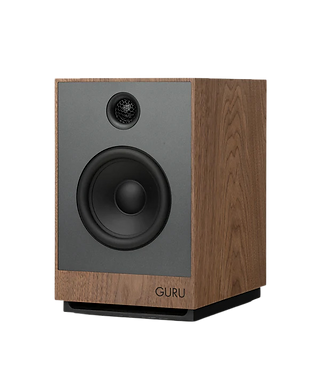
Guru Audio : Unique Swedish speakers designed to be placed against the wall, offering surprisingly deep bass and exceptional musicality.

Active speakers, stands and advanced connections
Active vs. Passive Speakers: This has become a key decision in recent years. Passive speakers are the classic choice where you need a separate amplifier. This gives you the freedom to mix and match and upgrade in the future. Active speakers , on the other hand, have an amplifier built in, which means easier setup, fewer cables and perfect synergy between the amplifier and speakers, as they were all designed by the same engineer. They are a great solution for minimalist yet powerful modern systems.
The Importance of Speaker Stands: With bookshelf speakers, stands are not just a piece of furniture. They are a key component. The right stand places the speaker at the optimal listening height (tweeter at ear level) and, more importantly, provides a solid, inert base. This prevents vibrations from being transmitted to the floor and back into the speaker, resulting in significantly more defined bass and a cleaner soundstage.
Bi-Wiring and Bi-Amping: Some speakers, like the PSB Imagine T65 or Synchrony T600 , have two pairs of connectors on the back. This allows for two advanced connection techniques. Bi-wiring involves using two separate cables from a single amplifier, one for the treble and one for the bass. Bi-amping involves using a separate amplifier channel for each frequency band. Both techniques can provide even greater precision and control over the sound.
Concrete suggestions from our offer
Speakers for smaller spaces where every centimeter counts:
JBL Stage2 250B : If you're looking for the most sound for your money, this is it. The Stage2 250B is a real workhorse, delivering that signature, energetic JBL sound in a compact form factor. It's a great first step into the world of true Hi-Fi.


Guru 8 : What if you need to push your speaker right up against a wall? The Guru 8 is a brilliant solution. This Swedish speaker uses the wall to its advantage, conjuring surprisingly deep and musical bass from a small enclosure.



JBL L52 Classic : The smallest member of the legendary Classic family, it delivers iconic retro style and surprisingly full, dynamic sound in an extremely compact form factor. It's the perfect choice for a desk or smaller space where you want sound with a rock 'n' roll character.


Speakers for larger rooms where you want power and fullness:
JBL Stage2 280F : When you need power you can feel more than hear, the 280F is here. With dual 8-inch woofers, it's ideal for home theater, where you want every explosion to grab your stomach, and for music that demands plenty of dynamics.


JBL L100 Classic MkII : There are speakers and there is the L100. This is not just a speaker, but a piece of history, updated for the 21st century. Its 12-inch bass and energetic character are the ticket to a concert experience in your living room. Uncompromising and legendary.


Listen with your ears.
Technical data and descriptions can only be a guide. In the end, the most important thing is to hear the speakers live in a controlled environment. Only then will you be able to determine which sound signature suits you best.
We invite you to our showroom to discuss your wishes and listen to the different options together. Our goal is to find speakers that will become the heart of your home and will bring you joy for many years.


Comments